
New backpack — check. New shoes — check. School supplies — check. Eye exam? Most parents don’t put this one on the back-to-school list, but they should. August is Children’s Eye Health and Safety Month, and it falls at exactly the right time: before the new school year begins, when catching vision problems early can make the difference between a child who thrives in the classroom and one who quietly struggles. Here’s what every Houston parent needs to know about children’s eye exams — and why this year’s school supply list should start at Berkeley Eye Center.
Fast Facts: Children’s Vision and School Performance
- 1 in 4 children has an undetected vision problem that directly impacts learning
- 80% of learning in the classroom is visual — reading, writing, board work, and screen time all depend on clear vision
- Children rarely report vision problems because they assume everyone sees the same way they do
- An eye exam is the only reliable way to detect conditions like amblyopia (lazy eye), strabismus, and refractive errors in children
- Vision can change rapidly between ages 6 and 18, making annual exams essential even when no problems are apparent
- Many school vision screenings only check distance vision — they miss farsightedness, astigmatism, and focusing problems that affect reading
Why a Back-To-School Eye Exam Is One of the Most Important Things You Can Do
Children’s vision has a direct, documented relationship with school performance. When a child can’t see clearly, the effects show up in the classroom — difficulty reading, trouble copying from the board, short attention span, and frustration that’s often misidentified as a behavioral problem or learning disability.
The challenge is that children don’t know what normal vision looks like. If your child has always seen the world slightly blurry or with double vision, they have no frame of reference to tell you something is wrong. They adapt — and struggle in silence. This is why the American Optometric Association recommends a comprehensive eye exam before the first grade and annually thereafter.
August is the ideal time to schedule. Appointments booked now are completed before the school year begins, giving your child the best possible start.
Warning Signs Your Child May Have a Vision Problem
Children give clues that something is wrong even when they can’t articulate it. Watch for any of these signs, especially as the school year begins:
Academic and behavioral signs:
- Avoids reading or loses their place frequently
- Holds books or devices very close to their face
- Covers or closes one eye while reading
- Complains of headaches after schoolwork or screen time
- Short attention span for reading tasks specifically
- Trouble copying from the board
Physical signs:
- Squinting or tilting the head to see
- Eyes that don’t appear to line up or move together
- Frequent eye rubbing or blinking
- Red, watery, or swollen eyes
- Complaints of double vision, blurry vision, or tired eyes
If you notice any of these signs, don’t wait for the next school screening. Schedule a comprehensive exam. School vision screenings test distance vision only and miss many of the conditions that affect classroom performance most.
What Happens During a Children’s Comprehensive Eye Exam?
A comprehensive eye exam at Berkeley Eye Center is very different from the vision screening your child receives at school. Our Houston optometrists and ophthalmologists evaluate:
- Visual acuity: Distance and near vision at multiple distances
- Refractive error: Nearsightedness, farsightedness, and astigmatism
- Binocular vision: How the eyes work together as a team
- Eye alignment and movement: Checking for strabismus (crossed eyes) and tracking problems
- Focusing ability: How well the eyes adjust between near and far distances
- Eye health: Internal and external exam for conditions including glaucoma, amblyopia, and retinal issues
The exam is gentle, non-invasive, and designed for school-aged children. The whole process typically takes 45 minutes to an hour.
Common Vision Conditions Found in School-age Children
Myopia (nearsightedness): The most common refractive error in children. Objects far away appear blurry. Children with myopia often struggle to see the board. Myopia is increasing rapidly in children, with Houston’s screen-heavy environment a contributing factor. It can be corrected with glasses or contact lenses, and myopia management options are available for children whose prescription is progressing quickly. Learn about your options for Myopia control for your child.
Hyperopia (farsightedness): Objects close up are blurry or require extra effort to focus. Children with significant farsightedness often experience headaches, eye strain, and reading difficulties. Many are misdiagnosed with attention problems before an eye exam reveals the real cause.
Astigmatism: An irregular corneal shape that causes blurry vision at all distances. Very common, very correctable, and frequently missed by school screenings.
Amblyopia (lazy eye): Reduced vision in one eye that the brain suppresses, often without the child or parent noticing. Treatment is significantly more effective before age 7 and becomes progressively harder with age. This is one of the most important reasons to start eye exams early; amblyopia has no symptoms the child can report.
Strabismus (crossed or misaligned eyes): When the eyes don’t point in the same direction. Can cause double vision, depth perception problems, and amblyopia if untreated. Early treatment produces the best outcomes.
Convergence insufficiency: Difficulty coordinating the eyes for close-up work. A common cause of reading problems, often confused with dyslexia or ADHD. Identifiable only through a comprehensive exam.
Eye Safety for Active Kids: Protecting Vision Year-Round
August isn’t just back-to-school season; it’s also the beginning of fall sports. Eye injuries are one of the leading causes of vision loss in children, and the vast majority are preventable with proper protective eyewear.
Talk with your child about eye safety and make protective eyewear part of their sports gear:
- Basketball, baseball, soccer, and racquet sports: Polycarbonate sports goggles are the standard recommendation
- Swimming: Chlorine and bacteria in pool water can cause eye infections; goggles protect the eyes
- Outdoor activities: UV-protective sunglasses should be as automatic as sunscreen on sunny Texas days
At Berkeley Eye Center, our optical shops carry protective eyewear in prescription and non-prescription options across all our Houston-area locations. Browse our eyewear options →
When Should Children Have Their First Eye Exam?
The American Optometric Association recommends:
- 6 months — first exam to check for early signs of eye problems
- Age 3 — before preschool begins
- Age 5-6 — before or at the start of school
- Annually from age 6-18 — especially important during school years when vision can change rapidly
Children with risk factors, such as family history of amblyopia, strabismus, or significant refractive error, premature birth, developmental delays, or previous eye conditions, should be seen more frequently.
Berkeley Eye Center’s comprehensive exams are available for children starting at age 7. For earlier screenings, ask your pediatrician about referral options.
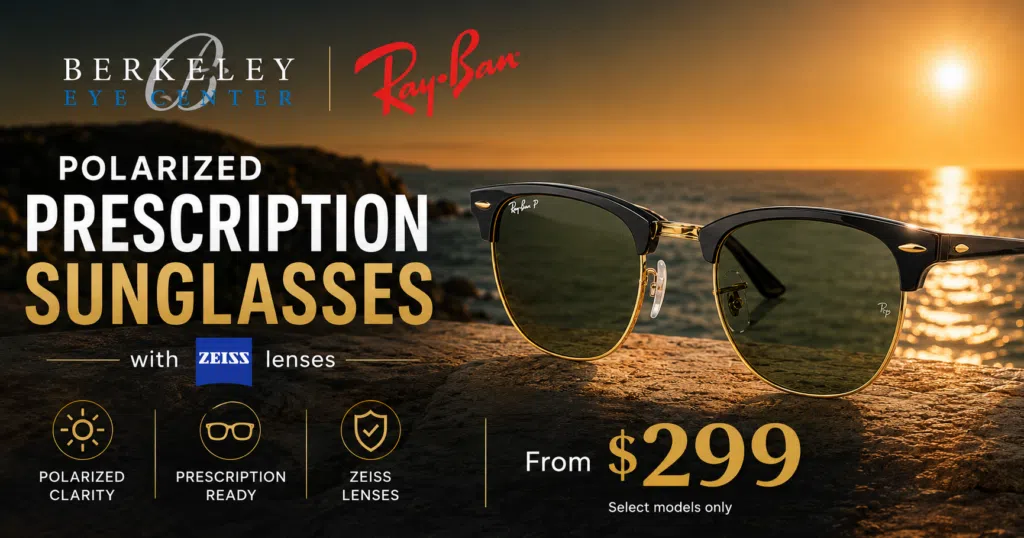
Our Optical Promotions



Frequently Asked Questions About Children’s Eye Exams
Give Your Child Their Best Shot at Success This School Year
Don’t let an undetected vision problem hold your child back. Schedule their back-to-school eye exam at Berkeley Eye Center before the school year begins — and start August with one less thing to worry about.
Berkeley Eye Center has 29 convenient locations across the Houston area, with family eye care services including comprehensive eye exams for children 7 and up, glasses, contact lenses, and treatment of eye conditions.