
Trusted by Texans for Over 70 Years
Your Trusted Choice for Presbyopia Treatment in Houston
Tired of holding menus at arm’s length? Frustrated with the constant on-and-off of reading glasses? You are not alone. This natural, age-related change in near vision is called presbyopia, and it affects nearly everyone starting in their 40s.
Berkeley Eye Center is a trusted leader in vision correction, offering a comprehensive suite of advanced treatments designed to address presbyopia. We combine decades of experience with state-of-the-art technology to help you reduce or even eliminate your dependence on reading glasses and bifocals.
What Is Presbyopia?
Presbyopia is the normal, age-related loss of the eye’s ability to focus on near objects. It is not a disease, but rather a natural process. As we age, the crystalline lens inside the eye becomes less flexible, making it difficult to focus light from near objects onto the retina.
This change typically becomes noticeable in our early to mid-40s and is why many people find themselves needing reading glasses for the first time. Presbyopia can affect you even if you’ve had perfect vision your whole life or have previously had LASIK.
On This Page
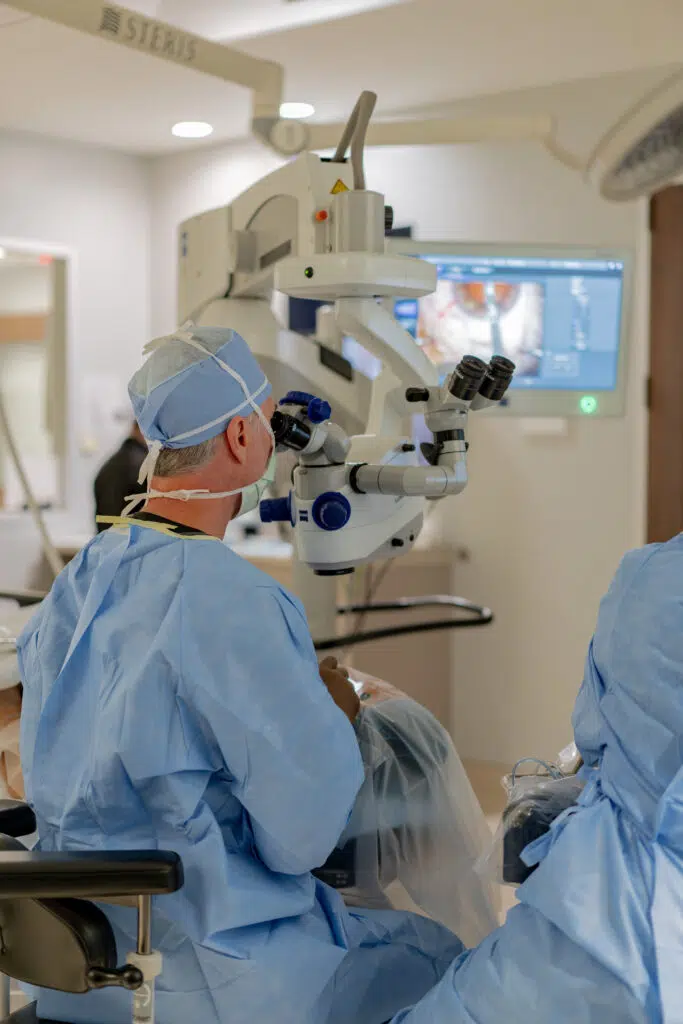
Unlock the Benefits of Presbyopia Treatment
Choosing a modern presbyopia treatment at Berkeley Eye Center can dramatically improve your quality of life:
Advanced Presbyopia Treatment Options
There is no one-size-fits-all solution for presbyopia. Our experienced surgeons will perform a comprehensive evaluation and recommend the best option for your unique eyes and lifestyle.
Refractive Lens Exchange (RLE)
RLE is often the most comprehensive and permanent solution for presbyopia. The procedure is virtually identical to modern cataract surgery. Your eye’s natural, dysfunctional lens is removed and replaced with an advanced intraocular lens (IOL) that is designed to provide clear vision at multiple distances. We offer a full range of Premium IOLs, including multifocal, trifocal, and extended depth of focus (EDOF) lenses, to customize your visual outcome.
Monovision LASIK
For patients who are also candidates for LASIK, Monovision LASIK is an excellent option. With this technique, the laser is used to correct one eye (typically your dominant eye) for clear distance vision, and the other eye for clear near vision. Your brain then learns to blend the two images together, providing functional vision at most distances. We often recommend a trial with monovision contact lenses first to ensure you adapt well to the experience.
Advanced Reading Glasses
For many, the first step in managing presbyopia is a high-quality pair of reading glasses or multifocal lenses (bifocals, progressives). Our skilled opticians can help you find the perfect optical solution, including specialized computer glasses to reduce digital eye strain.
Compare Your Presbyopia Treatment Options
|
Feature |
Refractive Lens Exchange (RLE) |
Monovision LASIK |
Advanced Reading Glasses |
|---|---|---|---|
|
Best For |
Patients 45+, especially with early cataracts |
LASIK candidates aged 40+ |
Patients wanting a non-surgical solution |
|
Corrects Vision |
Near, Intermediate & Distance |
One eye for near, one for distance |
Near (or Near & Distance with bifocals) |
|
Procedure Type |
Lens Implant Surgery |
Laser Vision Correction |
Non-Surgical |
|
Prevents Cataracts? |
Yes |
No |
No |
|
Reversible? |
No |
No (but can be enhanced) |
Yes |
The Treatment Process: What to Expect
Your journey begins with a free, comprehensive consultation to determine the best solution for you.
Is Presbyopia Treatment Safe?
Yes. Both RLE and Monovision LASIK are widely performed and have excellent safety profiles.
Am I a Candidate for Presbyopia Treatment?
Ideal candidates for surgical presbyopia correction are typically:
The only way to know for sure is through a comprehensive evaluation with one of our surgeons.

Understanding Cost & Affordability
Surgical presbyopia treatments are considered elective and are not typically covered by insurance. However, we offer several ways to make clear vision affordable:
Why Choose Berkeley Eye Center?
Frequently Asked Questions About Presbyopia Treatment
How successful are these presbyopia treatments?
Success rates are very high for both RLE and Monovision LASIK when patients are properly selected as candidates. For RLE with premium IOLs, clinical studies show that 85-95% of patients achieve functional vision without glasses for most daily activities, though many still prefer glasses for certain tasks like prolonged reading or night driving. For Monovision LASIK, among patients who successfully complete a contact lens trial, satisfaction rates are typically 85-90%. Your individual results will depend on many factors including your unique eye anatomy, your visual demands, and how well your brain adapts to the correction. During your consultation, we’ll provide realistic expectations based on your specific situation.
Will insurance cover my presbyopia treatment?
Presbyopia treatments like RLE and Monovision LASIK are considered elective vision correction procedures and are not covered by standard medical insurance. However, if you later develop cataracts, insurance would typically cover basic cataract surgery (though not the upgrade to premium lenses). Many patients choose to use their FSA or HSA pre-tax dollars, and we offer financing options through CareCredit® and Alphaeon® Credit to make treatment affordable. We’ll provide you with a detailed cost breakdown during your consultation.
What is the difference between RLE and Cataract Surgery?
The procedure itself is identical. The only difference is the reason for it. In cataract surgery, the goal is to remove a cloudy lens that is obstructing vision. In RLE, the goal is to replace a clear but dysfunctional lens to reduce or eliminate the need for glasses.
Will I still need glasses after presbyopia treatment?
The goal of treatments like RLE with premium lenses and Monovision LASIK is to significantly reduce your dependence on glasses. While many patients become completely glasses-free, some may still prefer to use a light pair of glasses for certain tasks, like reading very fine print or driving at night.
Can I “test drive” monovision before having LASIK?
Yes, absolutely. We highly recommend a trial period with monovision contact lenses. This allows you to experience how your brain adapts to this type of vision correction in your daily life before committing to a surgical procedure.
If I had LASIK in my 20s or 30s, why do I need reading glasses now?
LASIK permanently corrects the shape of your cornea to fix nearsightedness, farsightedness, or astigmatism. Presbyopia is a separate, age-related issue caused by the stiffening of the lens inside your eye. LASIK does not prevent presbyopia, but treatments like Monovision LASIK or RLE can help address it.
Take the First Step Towards Freedom from Reading Glasses
If you’re ready to explore a life with less dependence on reading glasses and bifocals, find out which presbyopia treatment is right for you. Schedule your complimentary, no-obligation consultation with the experienced team at Berkeley Eye Center today.