
Fast Facts: How Long LASIK Lasts
- LASIK permanently reshapes the cornea — the correction itself does not wear off
- Over 90% of LASIK patients maintain their results for 10+ years without any additional correction
- Age-related vision changes like presbyopia (reading vision loss after 40) are caused by the lens, not the cornea — LASIK doesn’t cause or accelerate these changes
- In rare cases, myopic regression can occur — most often in patients who had very high prescriptions
- Berkeley Eye Center includes medically necessary enhancement procedures within 2 years of your initial LASIK at no additional cost
- Annual eye exams remain important after LASIK to monitor overall eye health
Does LASIK Wear Off Over Time?
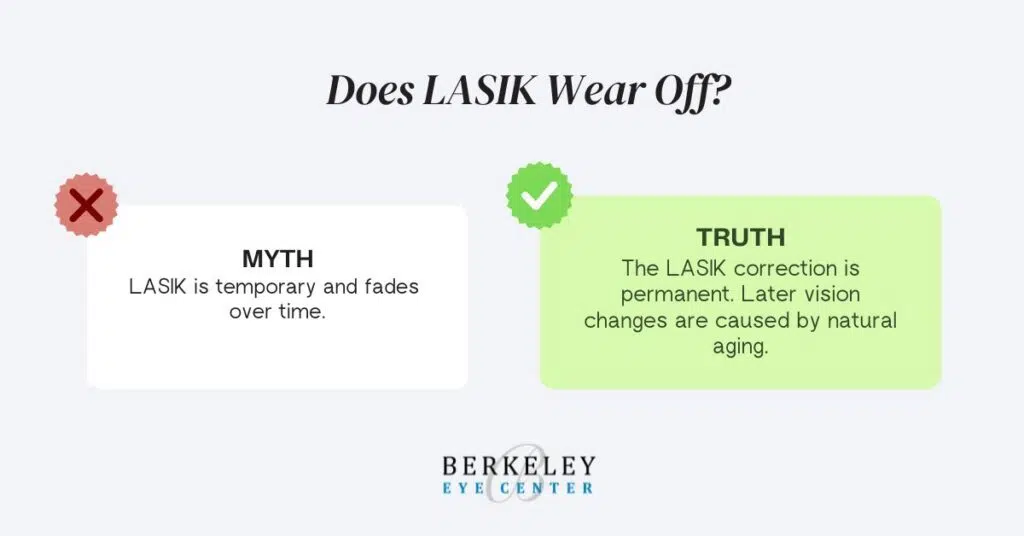
No — and this is one of the most persistent myths about laser vision correction. LASIK permanently reshapes the cornea using an excimer laser, removing microscopic amounts of tissue to change how light focuses on the retina. Because the cornea is physically altered — not chemically treated or temporarily adjusted — the correction cannot “wear off” the way a contact lens prescription might need updating.
Think of it this way: LASIK changes the shape of your cornea the same way a sculptor changes the shape of stone. Once the shape is changed, it stays changed.
The confusion often comes from patients who notice their vision changing years after LASIK — but in most cases, that change is caused by natural aging, not by LASIK fading.
How Your Eye Works — And Why Lasik Is Permanent
The cornea is the clear dome-shaped surface at the front of your eye. Light enters through the cornea, passes through the pupil and lens, and focuses on the retina at the back of the eye. Your brain interprets the retinal signal as the image you see.
When the cornea isn’t shaped correctly, light focuses in the wrong place — in front of the retina (nearsightedness) or behind it (farsightedness). LASIK precisely reshapes the cornea so that light focuses exactly on the retina. Once that reshaping is complete, the cornea retains its new shape permanently. There is no mechanism by which the cornea “bounces back” to its original shape after LASIK.
What actually happens during LASIK surgery — including how the laser tracks your eye throughout.
What Can Cause Vision To Change After Lasik?
While LASIK itself is permanent, your eyes continue to age — and age-related changes are the most common reason patients notice vision shifts years after their procedure. There are three main causes:
Presbyopia — the most common. Starting in your early-to-mid 40s, the natural lens inside your eye gradually loses flexibility, making it harder to focus on close objects. This is why people need reading glasses as they get older. Presbyopia is caused by the lens, not the cornea — LASIK has no effect on whether or when presbyopia develops. If you had LASIK in your 30s and notice reading difficulty in your 40s, that’s aging, not LASIK wearing off. Monovision LASIK is an option for patients over 40 who want to reduce dependence on reading glasses.
Cataracts — Cataracts develop when the natural lens inside the eye gradually becomes cloudy, causing blurry or hazy vision. This is a completely separate process from LASIK and has nothing to do with the corneal reshaping the procedure performed. Cataracts are one of the most common causes of vision changes in patients over 60, and their gradual onset is frequently mistaken for LASIK “wearing off.” The good news is that cataract surgery is one of the most successful procedures in medicine — and patients who’ve had LASIK are still excellent candidates.
Other eye conditions — In a small percentage of patients, most often those with very high prescriptions, some degree of nearsightedness can gradually return over years due to myopic regression. This happens because the cornea’s healing response causes very minor changes to the treated area and is more common with prescriptions above -8.00 diopters. Glaucoma and other conditions can also cause vision changes unrelated to LASIK. This is why annual comprehensive eye exams remain important even after achieving excellent post-LASIK vision — your surgeon can monitor overall eye health and catch any developing conditions early.
What Is LASIK Enhancement Surgery?
If your vision does change significantly after LASIK — whether from minor regression, a prescription shift, or another cause — an enhancement procedure may be an option. LASIK enhancement follows the same process as your original procedure: a laser is used to correct any remaining or returning refractive error, and the recovery process is similar. In most cases the results are excellent.
Not everyone is a candidate for enhancement — your surgeon will evaluate your corneal thickness, prescription stability, and overall eye health before recommending it. At Berkeley Eye Center, we perform a thorough evaluation to determine whether enhancement is the right solution for your specific situation. It’s worth noting that LASIK enhancement is typically not the recommended approach for presbyopia, which is better addressed through options like Monovision LASIK or other age-related vision correction procedures.
For a deeper look at when enhancement is appropriate and what it involves, read our guide: Do I need LASIK enhancement surgery?
How Long Does Lasik Last? What The Research Says

Long-term studies consistently support LASIK’s durability. Research published in peer-reviewed ophthalmology journals shows that the vast majority of patients maintain their corrected vision with minimal change over 10 years or more. A 2016 study published in the Journal of Refractive Surgery followed patients for 10 years and found that over 90% maintained vision of 20/40 or better — the legal driving standard — without glasses or contacts.
The bottom line: for most patients with moderate prescriptions, LASIK delivers permanent results that last a lifetime. The small percentage of patients who experience regression are typically candidates for enhancement.
Frequently Asked Questions About LASIK Longevity
Schedule Your Free LASIK Consultation in Houston
If you’re considering LASIK and want to know how long your results are likely to last based on your specific prescription and eye health, the best next step is a comprehensive candidacy evaluation. Our surgeons will review your corneal thickness, prescription history, and overall eye health to give you an honest assessment of what LASIK can deliver for your eyes specifically.
Schedule Your Free LASIK Consultation in Houston and Corpus Christi
View our current LASIK promotion and savings options — including 0% interest financing.