
When you think about cataract surgery, you probably do not immediately think about the International Space Station. But thanks to Berkeley Eye Center’s own Dr. Morgan Micheletti, the two are now connected through a groundbreaking collaboration with Space Center Houston, NASA, Aegis Aerospace and SpaceX that has carried his research to the International Space Station.
Watch Dr. Micheletti’s Journey to Space Research
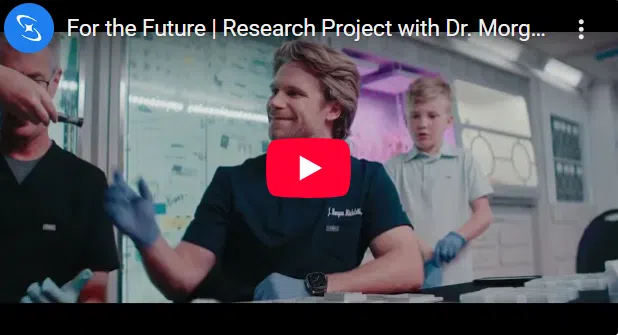
The Mission: Testing Tomorrow’s Cataract Surgery in Space
Dr. Micheletti and Berkeley Eye Center have partnered with Space Center Houston, NASA, and Aegis Aerospace on the JAMES mission: the Joint Assessment for Materials Exposure in Space. This innovative project sent cataract surgery materials in the form of intraocular lenses (IOLs) to the International Space Station (ISS) aboard a SpaceX Crew Dragon resupply mission in 2024 to test how they perform in the extreme conditions of space.
Dr. Micheletti serves as the Chief Investigator for the JAMES project, leading the scientific effort to study how intraocular lenses behave in this unique environment.
“On Earth, we know the temperature, humidity, and the sterility controls that are required to ship it from point A to point B,” Dr. Micheletti explains in the video. “But we don’t know that for space.”
Why This Research Matters for Your Eyes
While this might sound like pure space exploration, the implications reach far beyond astronauts. This research helps us understand:
- How surgical materials respond to extreme conditions
- The durability and stability of intraocular lenses under stress
- How we might safely transport surgical material to other planets
- New insights that could improve cataract surgery techniques here on Earth
It also begins to answer practical questions for the future, such as how to package and ship lenses safely on long missions and how to prepare for the day when someone needs cataract surgery on the Moon or on Mars.
By testing these materials in the harshest environment imaginable, we are pushing the boundaries of what is possible in eye care, which benefits every patient who walks through our doors.
A Personal Touch In The Mission Name
The JAMES mission is not only a technical acronym, but also a family story. JAMES stands for Joint Assessment of Material Exposure in Space, the formal name of the research project led by Dr. Micheletti that studies how intraocular lenses respond to the space environment on the exterior of the International Space Station.
Within that mission, the hardware that carried the lenses also has meaningful names. The small spaceflight carriers that traveled to the ISS are called CLAIRE units, which stands for Carrier for Lens Analysis in Interstellar Research Expeditions. These carriers were designed to hold and expose the lenses in different orientations to vacuum, radiation and temperature swings in low Earth orbit.
On Earth, a matching control unit holds an identical set of lenses. That unit is named WILLIAM, short for Worldly Interface for Lens Logistics and Integrated Astronomical Monitoring. WILLIAM stays safely on the ground and provides the comparison group for all of the lenses that return from space, so researchers can see exactly how the space environment changed the materials.
JAMES, WILLIAM and CLAIRE are all carefully constructed acronyms that describe the science, and they also share the names of Dr. Micheletti’s children. It is a quiet reminder that this project is about more than lenses and rockets. It reflects a hope that the work being done today will help future generations see clearly, whether they are here on Earth or someday living and working beyond it.
More Than a Museum: Space Center Houston’s Role
Many people think of Space Center Houston as simply a museum, but as Dr. Micheletti discovered, it’s much more. The center serves as a bridge between NASA’s cutting-edge research and the public, creating opportunities for private citizens and researchers to contribute to space exploration.
“Someone like me, just a private citizen who now has some research actually on the International Space Station,” Dr. Micheletti reflects. “And so that’s something that would not have been possible without Space Center Houston.”
The Passion Behind the Science
Dr. Micheletti’s interest in space began back in 3rd grade, when he chose the Apollo missions for his school’s annual GT presentation and had the chance to interview Gene Kranz, the NASA flight director best known for his leadership during Apollo era, notably Apollo 11 and Apollo 13. That conversation helped spark a lasting fascination with space exploration that now intersects with his work as a cataract and refractive surgeon in Houston. But what drives a surgeon to pursue research in space? For Dr. Micheletti, it comes down to one thing: pushing forward.
“I think I’ve always been a bit of a thrill seeker and that’s probably what led me to be a surgeon,” he says. “It’s about just pushing and driving forward. We can do that personally, we can do that as a team, and we can do that with technology. All of that together really just drives my overall passion for space and space travel.”
That same drive to push boundaries and embrace new technologies is what he brings to patient care every single day at Berkeley Eye Center.
The Rocket Launch Experience
Dr. Micheletti had the privilege of witnessing his research launch aboard a Falcon 9 rocket from the same launchpad that sent Buzz Aldrin and Neil Armstrong to the moon: Launch Complex 39A. But for him, the most inspiring part wasn’t just the spectacle—it was the community of scientists who were also present at the launch and working toward the same goal.
“All of these scientists are studying something different and we’re all trying to do the same thing. And that’s to push humankind forward,” he explains.
What This Means for Berkeley Eye Patients
When you choose Berkeley Eye for your cataract surgery or eye care needs, you’re choosing a practice where innovation isn’t just a buzzword—it’s a reality. Dr. Micheletti’s work across the latest developments in cataract, glaucoma, and space research demonstrates our commitment to:
- Staying at the forefront of ophthalmic research
- Using the most advanced surgical techniques and materials
- Continuously improving patient outcomes through scientific exploration
- Bringing world-class expertise to our local community
Experience the Difference
Dr. Micheletti’s research journey from Berkeley Eye Center to the International Space Station is more than just an impressive achievement—it’s a testament to the level of expertise and innovation you can expect when you trust us with your vision.
Ready to see the difference that cutting-edge expertise makes? Schedule a consultation with Dr. Micheletti and our team today.
Learn More:
- Meet Dr. Morgan Micheletti – Discover more about his expertise and approach to patient care
- Premium Cataract Surgery – Explore the advanced procedures and materials we offer
- Custom Lens Options – Find the right intraocular lens for your vision goals
- Space Center Houston’s Research Programs – See more about their groundbreaking work
The JAMES mission represents a collaboration between Dr. Morgan Micheletti, Space Center Houston, Aegis Aerospace, and multiple industry partners working together to advance the future of eye care—both on Earth and in space.